Sunday, January 5, 2014

The Princes Of Ireland The Dublin Saga


I started reading this book over the Christmas holidays and thus had no time to begin the blog.  Then I continued to read it during my trip down and back to Vero Beach, FL for New Year's Eve and again had not time to write anything on the blog.  And this is definitely a book that one wants to write a LOT!  I don't know if I can go back and capture all that has happened thus far.  Too many characters.....too many events....However, I can say that I did not turn this book off from being tired of it in the entire trip.  

The first section of the book is about Fergus and his daughter Deidre who live at Dubh Linn.  The time period is AD 430.  Deidre falls in love with Conall.  Conall is the perfect prince.   Their son is Morna.   Morna is raised in the home of Fergus because of his father's sacrifice.  I totally enjoyed the first part of the book with its twists and turns.  This section of the book ends with St Patrick converting the family from being Pagan to Christianity.  He then takes Morna with him which is against the hopes of Larine (the former Druid).  St. Patrick's words are:  "I returned to this island to bring the Gospel's joyful message to the heathen, Larine.  Not to make martyrs......Morna is a chief.  The ford is a crossroads.  Who can tell what Dubh Linn may be worth?"  Deidre is very happy that St Patrick has found a way to keep from sending her son to Tara for the new High King's fees ....his coronation.  Deidre worried about the safety of sending her son to the feis.  


The next section takes place in 981.  The main characters are Harold who is Norwegian and begins with his father, Olaf, taking him to visit Dyflin.  Also Osgar and his cousin Caoilinn who are both descendants of Fergus.  Morann Mac Goibnenn (MacGowan) is the jeweler who is friend to Harold.  


.....I did very little writing in the middle of the book as I was reading during the holidays and then on the trip to FLA and back.  But something came up in the book today and I wanted to add it here:

Tom Tidy overhears a message between a young girl with green eyes and a man while praying in the church that seems to be about the O'Byrnes coming .....They are in the church at Dalkey....but the message is that the O'Byrnes will come to Carrickmines.  So here is information about both of those places:

Wikipedia says that Dalkey is:
Dalkey (IrishDeilginis, meaning "thorn island") is a suburb of Dublin and seaside resort just south of Dublin CityIreland. It was founded as a Viking settlement and became an important port during the Middle Ages. According to John Clyn, it was one of the ports through which the plague entered Ireland in the mid-14th century. In modern times, Dalkey has become a thriving seaside suburb and a minor tourist attraction. It has been home to many writers and celebrities including Maeve BinchyHugh LeonardBono and Van Morrison.

......too much happened without my writing.....if I plan a trip to Dublin, I will reread

However in Sept 2014 I turned the book back on.  The time period in the Dublin area is 1592.  And a huge reception/party is being held to celebrate the founding of what is now Trinity College/University of Dublin.  The  main characters in the book in this time period are Joan Butler who married Doyle.  And Margaret who is a distant kin of Joan's husband.  Their is a huge misunderstanding because of an ancient feud over inheritance.  Margaret's father has told her that the husband's family "stole" his inheritance and thus they are poor while the other family is rich.  This is an English family that lives within the pale.  The main person founding the college and giving the party is a Fitzgerald.  The book refers to him as Kildare.  The story that Joan's husband tells to her is very interesting. 


Joan's one wish at the party is to meet "Kildare".  It happens early in the event.  He is dressed in a style that Joan has NEVER seen before.  His dress is influenced by the court of Henry VIII.  The information leading up to their meeting is that Kildare's father has sent him to the English court numerous times,  He has become a friend to the English kings.  As such he is left to rule Ireland almost as the High Kings of olden times have done.  He collects taxes but does not send them on to England ......thus becoming very rich....the reason that he can found this new college,  Joan's husband tells the story that during the reign of Henry VIII's father, he had two advisors who served him well.  When the king died, the coffers of the crown were richer than they had ever been,  But Parliament believed that reform needed to happen and wanted to impeach the two advisors,  The men were close to the new king, Henry Viii.....like uncles to him,  He had both men executed because it suited his purposes,  Joan's husband tells the story to illustrate the fact that being a friend to the king is very dangerous.

I found this map of Dublin 1610 in many places:


Below is a modern map of Trinity College.  Trinity College is now located inside Dublin's city limits.  This map helps put a perspective on the more ancient maps.


I found an 1840 map of Trinity College at:  


I found the following post card at:


I viewed other maps of early Dublin at:  https://www.behance.net/gallery/Medieval-Dublin/2801385
There is a particularly nice enhanced map of Dublin in 1500 which is well worth taking the time to look at.  The project is by Dara Smith.  

And the following map at Wikipedia:


Monday, December 2, 2013

King's Mountain


Sharyn McCrumb's Ballad NovelsThrough the Ballad Novels, McCrumb celebrates her ancestors and the land of the mountain South, crafting a story rich with tradition and the true character and spirit of that breathtaking region. The novels are listed in order most recently published.

King's Mountain is a subject of great interest to me.  Every year I think that I might go on the reenactment that is done between Fort Wautauga and King's Mountain.  So when I saw Sharyn's newest ballad Novel was about these events I bought it to listen to via audible.com.

The first section of the book tells the story of a French family living in the Pyrannees between France and Spain.  The family was Huguenot.  John Sevier

Wikipedia says of Huguenots:

The Huguenots (/ˈhjuːɡənɒt/ or /hɡəˈn/French: [yɡno][yɡəno]) were members of the Protestant Reformed Church of France during the 16th and 17th centuries. French Protestants were inspired by the writings of John Calvin in the 1530s, and they were called Huguenots by the 1560s. By the end of the 17th century and into the 18th century, roughly 500,000 Huguenots had fled France during a series of religious persecutions. They relocated to Protestant nations, such as England, Wales, ScotlandDenmarkSwedenSwitzerland, the Dutch Republic, the Electorate of Brandenburg,Electorate of the Palatinate (both in the Holy Roman Empire), the Duchy of Prussia, and also to Cape Colony in South Africa and several of the English colonies of North America which were willing to accept them (colonies such as Maryland and Massachusetts denied settlement except to members of certain religions).

Don Juan De Xavier was born in Navarre, France in 1652, he married Marie Maris, who was born in 1654. They had one son, who was named Valentine Xavier, he was born in 1678 in Navarre, France. 


This couple's son Valentine was born in this region, but left as France was too dangerous for Huguenots in his lifetime.  He moved to England, married an English wife, changed his name to Sevier.  I is in England that William Sevier was born to Valentine and his English wife.  William Sevier moved to the Shenanadoah Valley where he was a farmer and also kept a small store.  

John Sevier was the oldest of William's children. Sharon says in the book that the combination of being the oldest of a large brood of children with a father who liked to drink and gamble along with a chance meeting with an old priest who told him that he had the bloodline to a saint and thus was blessed gave John Sevier the feeling that he would succeed and a great deal of confidence along with a feeling of duty towards those around him.

The Sevier family lived along the Great Wagon Road according to Sharon.  One day they became tired of seeing everyone moving south on the road and they decided to move.  The entire family moved to an area that was very near Ft Lee  (see map below):  

Fort Watauga, more properly Fort Caswell, was an American Revolutionary War fort that once stood at the Sycamore Shoals of the Watauga River in what is now Elizabethton, Tennessee. The fort was originally built in 1775–1776 by the area's frontier government, the Watauga Association, to help defend Watauga settlers from Native American (primarilyCherokee) attacks, which were in part instigated by the British.


The Watauga settlers, meanwhile, had been anticipating a Cherokee invasion. Arms and ammunition were purchased through the Fincastle County, Virginia Committee of Safety, food and medicine were gathered, and various forts were constructed or strengthened, among them Fort Caswell (now called Fort Watauga). In early July, Cherokee Beloved Woman Nancy Ward tipped off the Cherokee invasion plans to trader Isaac Thomas, and Thomas proceeded to deliver the news to John Sevier, who was at the Nolichucky settlement (near modern Limestone) overseeing the construction of Fort Lee. The news alarmed the settlers, and most of them fled to Fort Caswell, forcing Sevier to flee likewise and abandon Fort Lee's completion.[5]   This information is from Wikipedia 

The statement that Sharyn makes helped me understand the early years when the Revolution was mainly about fighting Indians in the areas that I look at historically.  She says that the people in the Eastern part were fighting for ideals....unfair taxes etc....but the people in the backwoods were fighting for their land.  The English were furnishing arms to the Indians to help them run the white settlers off their lands.  My own interpretation is that the English thought that they were giving allies arms to fight their battles on the frontier, but what really happened is that men who might never have entered the battles of the Revolutionary War became incensed at what the British were doing.  On the above map according to Wikipedia, John Sevier and his family were living near Ft. Lee.  It was Ft. Lee that they were building and it was burned during this summer of 1776.  

The settlers in the back country of Virginia and NC decided to fight the British BEFORE they moved north to fight on these settler's own turf....marching south to fight instead of waiting until the British moved into their home lands.

This part of the story that I have described above of King's Mountain is augmented by the story of Patrick Ferguson.  This part is told from the voice of Virginia Sal who is a camp follower who is maid and female companion to Ferguson.  I read this book via audible.

Wednesday, November 13, 2013

Mr. Penumbra's 24-hour Bookstore

Mr. Penumbra's 24-hour Bookstore  A Novel by Robin Sloan


I wasn't going to write this book up on my blog....hmmmm...I am 66 and this book is definitely not written for someone over 40.  But then there were thoughts that I wanted to put down...ideas that I did not want to loose.  So here it is.  I'll start with  review by M. Hollingsworth (wonder if this person descends from our Hollingsworth Quakers from Newberry and Ohio?)

Format:Hardcover
There's so much in this slim volume that I'm not sure where to start. Here's the TLDR version: it's an utter delight, and you should buy it immediately.

Our hero is a graphic designer with some meager programming skills who is left jobless by the recession. He finds new work as a bookstore clerk, and soon discovers that the store is much more than it seems. His quest to uncover its secrets leads only to mysteries, eventually sending him not only across the country but (figuratively) back in time to when the technology to make books widely accessible first became available.

Now my comments:  I am listening to the book via audio.com download.  Hmmmmm....so many thoughts....take my time and put a few of them down.  Already that fact is one of the thoughts.  I remember when I was in high school going to Davis and Elkins College (I belonged to Enslow Park Presbyterian Church and that was what one did in those days while in high school) for a visit to access my skills and interests while looking for what I might want to do with the rest of my life.  I was told that my interest level was that of a ditch digger or a kindergarten teacher.  I think that the idea was that I was TOOOOO interested in EVERYTHING!  I was not focused enough.  And that indeed has been my problem all of my life.  I surround myself with things that are of great interest to me, but my time is (thank goodness) limited by all of my real life (family, friends, golf, tennis, etc)....so that I find myself in my free time CONSTANTLY thinking:  is this what I want to do with this ten minutes?  So the audio book connection has let me "read" fiction and etc that I might not take the time to read via paper or digital form.  I am just driving to Starbucks, so I can read such and such.....I can't watch TV because it feels like wasted time to me.  i don't read the paper because I would rather read my computer.  I don't turn on a movie because I have piles of books and magazines that I want to look at.  

In this book the characters do jobs that take incredible amounts of time....in their spare time they do things like make a model of a book that takes hours and hours and hours and hours....and I realize that my genealogy "game" is much like that.  Someone else might not be willing to spend those kinds of hours.  But it is interesting that we all choose what we do with our spare time.  The hero's roommate spends incredible hours making amazing models (much like model train models without the train) out of scraps of whatever.

The ideas that had me running to my computer this morning are this:

First of all, on the hero's visit with Cat to Google headquarters, is his description of the workplace pure fiction or does he actually have inside information on the workspace?  The running of the company being done by a committee that is chosen randomly for 12 months and the comparison of Google and America....and the idea that our country could be run by a committee chosen randomly.   It is absolutely fascinating.  The hero says:  "it is so egalitarian that it is beyond democracy"

Second, the idea of OK (old knowledge) and TK (traditional knowledge).  In chapter 11....someone at lunch is explaining the ideas of trying to get all of the OK and TK into google....hmmmmm.....

As I finish the book this morning just before Thanksgiving 2013, I have found the book to be very entertaining....perhaps a bit silly and tongue in cheek.....but a very fun read.  There were lots of ideas that fit into what is going on in my own life right now as I make decisions on where my own life leads.  The ideas in the book about actual books and digital forms ....the ideas in the book about what makes immortality....the ideas in the book about what one does with one's time have made me do some thinking.  Give Clay's story (written by Robin Sloan) a try.


Wednesday, October 30, 2013

Nancy Wake


This book by Peter Fitzsimons is a book about an extraordinary life set in World War II.  It reminds me of a Nancy Drew book for adults.  I really liked the book.  I was a bit bogged down in the middle, but could not help but want to finish to see what Nancy's next adventure might be.  It helped knowing that Nancy survived from the very beginning as the author begins by talking about an interview with Nancy long after WW II.  I listened to this book via audible.

Saturday, July 20, 2013

The Winter Sea


History has all but forgotten...In the spring of 1708, an invading Jacobite fleet of French and Scottish soldiers nearly succeeded in landing the exiled James Stewart in Scotland to reclaim his crown....


I would classify The Winter Sea as fitting into the genre of romance which is not my favorite.  However Susanna Kearsley feeds wonderful history to the reader so well that I could not quit reading.  There is a scene in which Graham Keith, the son of the main character's landlord, summarizes the English/Scots Stewart Kings so well, that I wanted to copy them into this post (feel free to skip if you are not into Scots history):

"Robert the Bruce.....(think Braveheart) was the King of Scotland.....his daughter married onto the High Steward, so from that you've got the "Stewart" line which went through two more Roberts and a heap of Jameses before coming down to Mary Queen of Scots. ... And Mary's son, James, became heir to Queen Elizabeth of England, who died without a child.  So now you have a Stewart being king of both England and Scotland, though he acts more English than Scots now ....never setting a foot up in Scotland.  Nor does his son, Charles, who gets too cocky with his powers.  So along comes Cromwell and his men to say they have had enough of kings.  So they depose Charles and cut off his head.

Then the English, after years of Civil War and having Cromwell and his parliament om charge for a while, decide that they would be better off with a king and invite the old king's son, Charles Stewart (Charles II) to come back and take the throne.  And when he dies in 1685, his brother, James, takes the throne.  Which would not have been a problem, but James was Catholic.  VERY Catholic.  And not only do the English fear that he is trying to edge out their hard won Protestant religion, but they also fear he will enter into an alliance with the Catholic King of France....their worst enemy.

.....So the British look around for a Protestant replacement and find the perfect candidate as James' eldest daughter, Mary, had married a Protestant husband William of Orange.....

But just as the aristocrats are getting things in place, James' second wife gave birth to a son...and what comes next is not exactly a war, but more like a chess game with knights and nobles changing sides until about six months later James, his wife, and his new son flee to France.  

There are now two factions....those who support Mary and William of Orange and those who feel that James and his new son are the true rulers and wish to put them back on the throne... this faction is called Jacobites from Jacobus which is the Latin name for James."  I am going to quit copying....but one can find the rest starting on page 200 of the paperback book


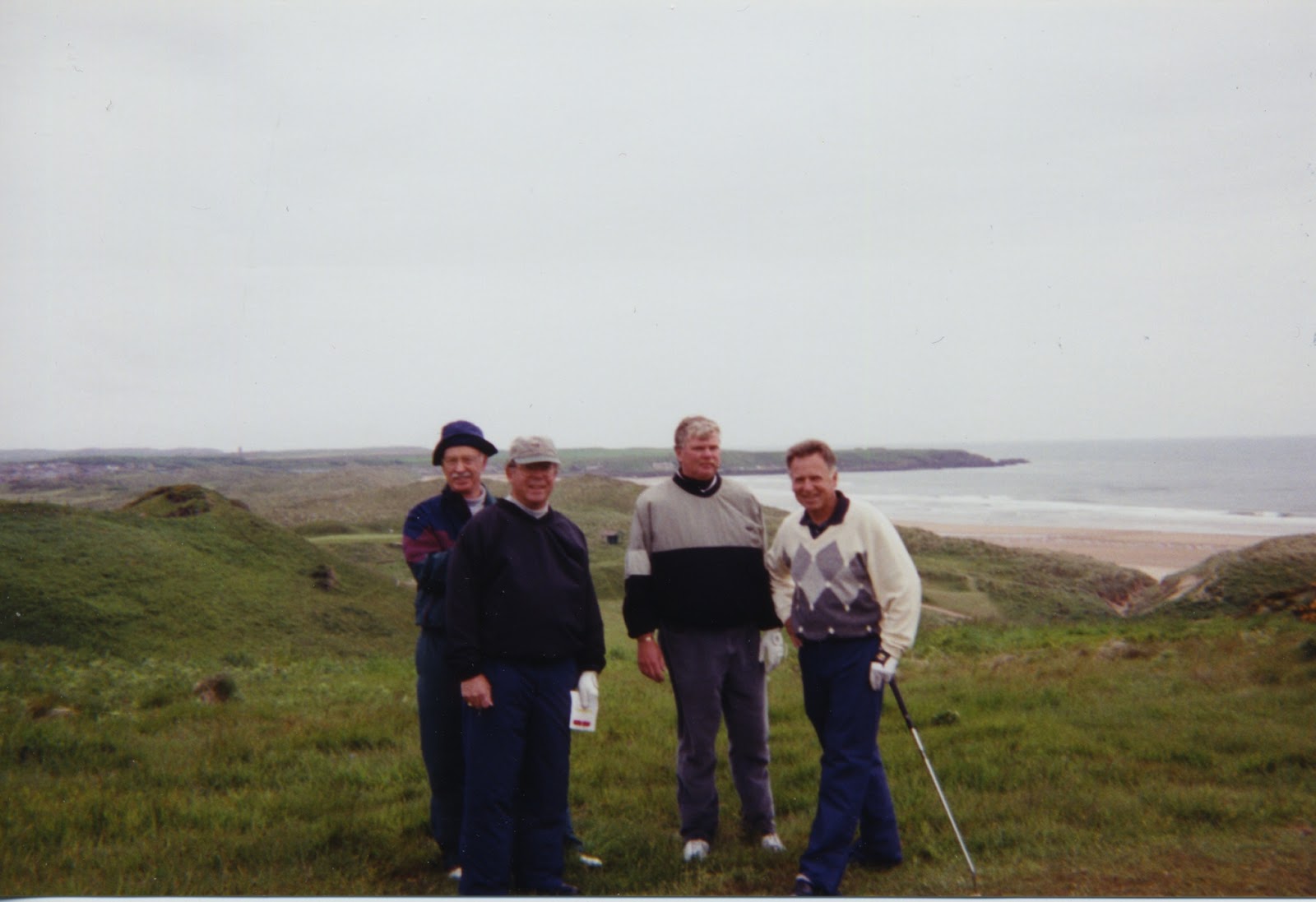
The story takes place at Cruden Bay on the east coast of Scotland.  My husband, Jack, and I visited this spot in 1998 with Jack's golf buddies and their wives.  I only wish that this book had been available in 1998.  I would loved to have read it as a part of our trip.  As I remember none of us visited the ruins of Slains Castle while we were there.  If I had read the book, I am sure that I would have been very interested in the 1708 event that this book is about and in seeing the ruins.  Certainly I spent MANY hours reading about Culloden in preparation for the trip.

Below is a photo of my husband (far right) and his buddies on the Cruden Bay golf course.


 I would recommend the book to anyone who likes historical fiction and who is interested in Scottish History of the 1700's.


While browsing the internet for some information about Cruden Bay golf, I found the following WONDERFUL film that shows the golf course c.1914.  This short film is NOT to be missed if you have any interest at all in Cruden Bay:

http://ssa.nls.uk/film.cfm?fid=3007

and to:

http://www.youtube.com/watch?v=fDr8aN19bfU

for a tour of the course.  And to:

http://top100golf.blogspot.com/2009/05/cruden-bay-golf-club.html

for a wonderful blog post that also includes photos of the course and a narrative that explains why it is so special.  I wish that I had asked my husband to say which of the courses he liked the most on that trip.  I have this book on audio and KOBO; I am reading it via audible.com.

I just finished the book yesterday.  I would have to say that the ending is lots of fun!  This lady did a VERY good job of making the book encompass two very separate eras and, of course, I loved the references to genealogy research.  Susannah Kearsley did an excellent job of weaving many themes into her book.


Wednesday, April 3, 2013

Roots


I am reading Roots in April 2013.  It is very interesting to me that it came out in a time in which I should have been interested in the book.  However, I was involved with young children and I guess that I was pretty much unaware of anything but my family in that time period.  It is amazing that I have never read this book before.

From Wikipedia:

Brought up on the stories of his elderly female relatives—including his Grandmother Cynthia, whose father was emancipated from slavery in 1865—Alex Haley claimed to have traced his family history back to "the African," Kunta Kinte, captured by members of a contentious tribe and sold to slave traders in 1767. In the novel, each of Kunta's enslaved descendants passed down an oral history of Kunta's experiences as a free man in Gambia, along with the African words he taught them. Haley researched African village customs, slave-trading and the history of African Americans in America—including a visit to the griot (oral historian) of his ancestor's African village. He created a colorful history of his family from the mid-eighteenth century through the mid-twentieth century, which led him back to his heartland of Africa.

and

Roots: The Saga of an American Family is a novel written by Alex Haley and first published in 1976. It tells the story of Kunta Kinte, an 18th-century African, captured as an adolescent and sold into slavery in the United States, and follows his life and the lives of his alleged descendants in the U.S. down to Haley. The release of the novel, combined with its hugely popular television adaptation, Roots (1977), led to a cultural sensation in the United States. The novel spent weeks on The New York Times Best Seller List, including 22 weeks in that list's top spot. The last seven chapters of the novel were later adapted in the form of a second miniseries, Roots: The Next Generations, in 1979.
Following the success of the original novel and the miniseries, Haley was sued by author Harold Courlander, who successfully asserted that Roots was plagiarized from his own novel The African, published nine years prior to Rootsin 1967. The resulting trial ended with an out-of-court settlement and Haley's admission that some passages within Roots had been copied from Courlander's work.
As for the novel's historical accuracy, researchers have cast doubts on whether Haley truly tracked down his ancestry to a specific village and individual, or was merely being told what he wanted to hear by the people who lived there.


First part of the book is about the time in Africa.  When Kunta Kinte looses his beloved grandmother, his father tells him that there are three kinds of people in the village.  Kunta is comforted by his father's explanation:  the first kind are those who are alive and go about eating and working.  The second kind are the ancestors whom his grandmother has just joined.  And the third are the people who are waiting to be born.  It is interesting to me that these people spent eight days choosing a name for their male children trying to choose something from their ancestry....how much their ancestors were indeed a part of their lives in the stories passed down.  We, as a people, have lost that concept of living among our ancestors.  

Tuesday, March 5, 2013

The Education of Little Tree


This book is about a very young boy who is orphaned and then adopted by his Cherokee Grandmother and his half-cherokee, half-Scots grandfather.  Their life in the mountains of Tennessee during the Great Depression is a learning experience for the reader as well as for Little Tree.

..... I really like the idea of people who want to own and have more than they need are the root of all evil.  If you only need three turkeys to survive, you only kill three turkeys even though you catch six in your trap.  And today's description of the Cherokee being run of the land and what we know as the Trail of Tears causes me infinite pain.

This book will make you rethink your own life.