
Wednesday, October 30, 2013
Nancy Wake

Saturday, July 20, 2013
The Winter Sea

History has all but forgotten...In the spring of 1708, an invading Jacobite fleet of French and Scottish soldiers nearly succeeded in landing the exiled James Stewart in Scotland to reclaim his crown....
I would classify The Winter Sea as fitting into the genre of romance which is not my favorite. However Susanna Kearsley feeds wonderful history to the reader so well that I could not quit reading. There is a scene in which Graham Keith, the son of the main character's landlord, summarizes the English/Scots Stewart Kings so well, that I wanted to copy them into this post (feel free to skip if you are not into Scots history):
"Robert the Bruce.....(think Braveheart) was the King of Scotland.....his daughter married onto the High Steward, so from that you've got the "Stewart" line which went through two more Roberts and a heap of Jameses before coming down to Mary Queen of Scots. ... And Mary's son, James, became heir to Queen Elizabeth of England, who died without a child. So now you have a Stewart being king of both England and Scotland, though he acts more English than Scots now ....never setting a foot up in Scotland. Nor does his son, Charles, who gets too cocky with his powers. So along comes Cromwell and his men to say they have had enough of kings. So they depose Charles and cut off his head.
Then the English, after years of Civil War and having Cromwell and his parliament om charge for a while, decide that they would be better off with a king and invite the old king's son, Charles Stewart (Charles II) to come back and take the throne. And when he dies in 1685, his brother, James, takes the throne. Which would not have been a problem, but James was Catholic. VERY Catholic. And not only do the English fear that he is trying to edge out their hard won Protestant religion, but they also fear he will enter into an alliance with the Catholic King of France....their worst enemy.
.....So the British look around for a Protestant replacement and find the perfect candidate as James' eldest daughter, Mary, had married a Protestant husband William of Orange.....
But just as the aristocrats are getting things in place, James' second wife gave birth to a son...and what comes next is not exactly a war, but more like a chess game with knights and nobles changing sides until about six months later James, his wife, and his new son flee to France.
There are now two factions....those who support Mary and William of Orange and those who feel that James and his new son are the true rulers and wish to put them back on the throne... this faction is called Jacobites from Jacobus which is the Latin name for James." I am going to quit copying....but one can find the rest starting on page 200 of the paperback book

"Robert the Bruce.....(think Braveheart) was the King of Scotland.....his daughter married onto the High Steward, so from that you've got the "Stewart" line which went through two more Roberts and a heap of Jameses before coming down to Mary Queen of Scots. ... And Mary's son, James, became heir to Queen Elizabeth of England, who died without a child. So now you have a Stewart being king of both England and Scotland, though he acts more English than Scots now ....never setting a foot up in Scotland. Nor does his son, Charles, who gets too cocky with his powers. So along comes Cromwell and his men to say they have had enough of kings. So they depose Charles and cut off his head.
Then the English, after years of Civil War and having Cromwell and his parliament om charge for a while, decide that they would be better off with a king and invite the old king's son, Charles Stewart (Charles II) to come back and take the throne. And when he dies in 1685, his brother, James, takes the throne. Which would not have been a problem, but James was Catholic. VERY Catholic. And not only do the English fear that he is trying to edge out their hard won Protestant religion, but they also fear he will enter into an alliance with the Catholic King of France....their worst enemy.
.....So the British look around for a Protestant replacement and find the perfect candidate as James' eldest daughter, Mary, had married a Protestant husband William of Orange.....
But just as the aristocrats are getting things in place, James' second wife gave birth to a son...and what comes next is not exactly a war, but more like a chess game with knights and nobles changing sides until about six months later James, his wife, and his new son flee to France.
There are now two factions....those who support Mary and William of Orange and those who feel that James and his new son are the true rulers and wish to put them back on the throne... this faction is called Jacobites from Jacobus which is the Latin name for James." I am going to quit copying....but one can find the rest starting on page 200 of the paperback book

The story takes place at Cruden Bay on the east coast of Scotland. My husband, Jack, and I visited this spot in 1998 with Jack's golf buddies and their wives. I only wish that this book had been available in 1998. I would loved to have read it as a part of our trip. As I remember none of us visited the ruins of Slains Castle while we were there. If I had read the book, I am sure that I would have been very interested in the 1708 event that this book is about and in seeing the ruins. Certainly I spent MANY hours reading about Culloden in preparation for the trip.
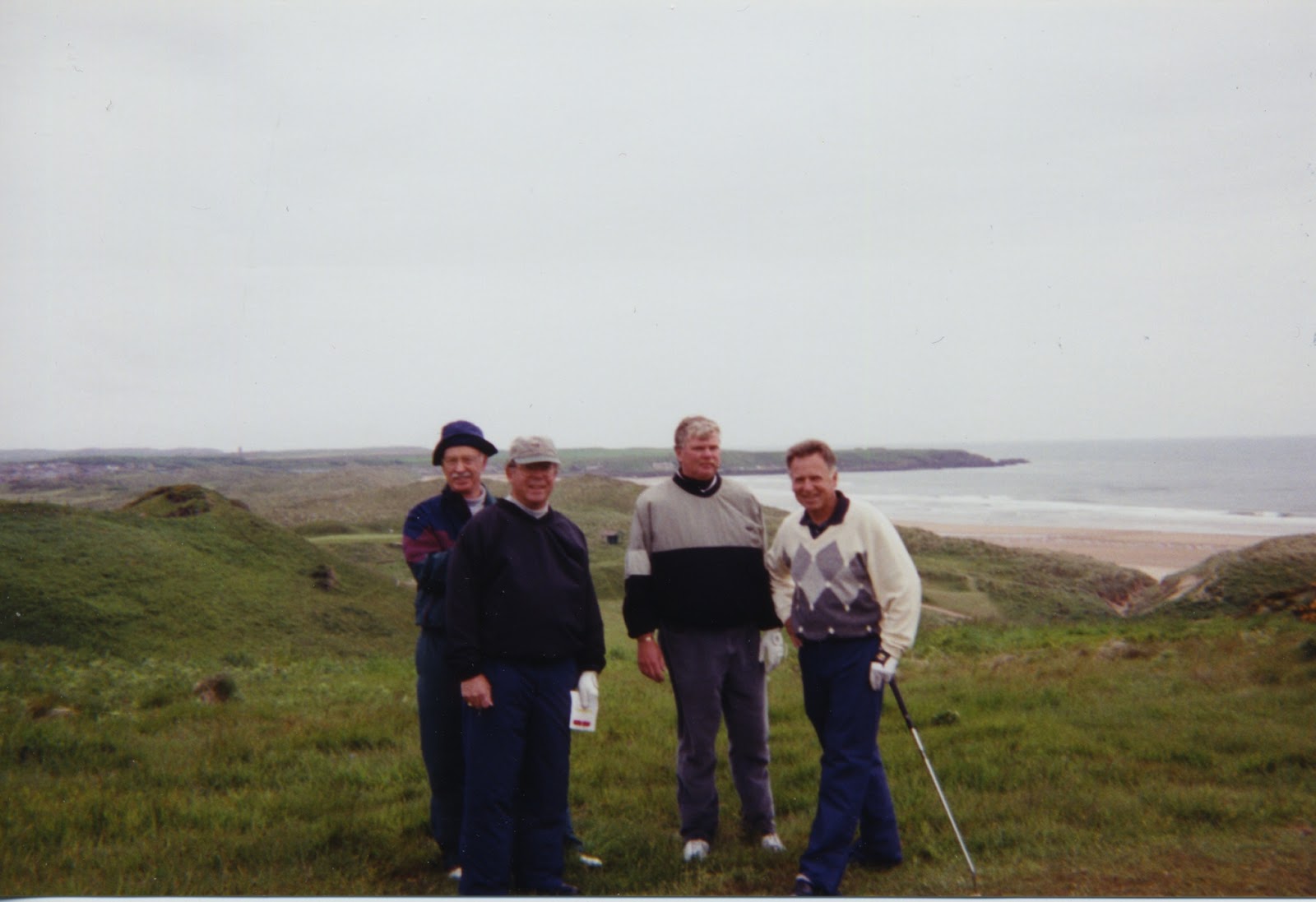
Below is a photo of my husband (far right) and his buddies on the Cruden Bay golf course.

I would recommend the book to anyone who likes historical fiction and who is interested in Scottish History of the 1700's.
While browsing the internet for some information about Cruden Bay golf, I found the following WONDERFUL film that shows the golf course c.1914. This short film is NOT to be missed if you have any interest at all in Cruden Bay:
http://ssa.nls.uk/film.cfm?fid=3007
and to:
http://www.youtube.com/watch?v=fDr8aN19bfU
for a tour of the course. And to:
http://top100golf.blogspot.com/2009/05/cruden-bay-golf-club.html
for a wonderful blog post that also includes photos of the course and a narrative that explains why it is so special. I wish that I had asked my husband to say which of the courses he liked the most on that trip. I have this book on audio and KOBO; I am reading it via audible.com.
I just finished the book yesterday. I would have to say that the ending is lots of fun! This lady did a VERY good job of making the book encompass two very separate eras and, of course, I loved the references to genealogy research. Susannah Kearsley did an excellent job of weaving many themes into her book.
Below is a photo of my husband (far right) and his buddies on the Cruden Bay golf course.
I would recommend the book to anyone who likes historical fiction and who is interested in Scottish History of the 1700's.
While browsing the internet for some information about Cruden Bay golf, I found the following WONDERFUL film that shows the golf course c.1914. This short film is NOT to be missed if you have any interest at all in Cruden Bay:
http://ssa.nls.uk/film.cfm?fid=3007
and to:
http://www.youtube.com/watch?v=fDr8aN19bfU
for a tour of the course. And to:
http://top100golf.blogspot.com/2009/05/cruden-bay-golf-club.html
for a wonderful blog post that also includes photos of the course and a narrative that explains why it is so special. I wish that I had asked my husband to say which of the courses he liked the most on that trip. I have this book on audio and KOBO; I am reading it via audible.com.
I just finished the book yesterday. I would have to say that the ending is lots of fun! This lady did a VERY good job of making the book encompass two very separate eras and, of course, I loved the references to genealogy research. Susannah Kearsley did an excellent job of weaving many themes into her book.
Wednesday, April 3, 2013
Roots


I am reading Roots in April 2013. It is very interesting to me that it came out in a time in which I should have been interested in the book. However, I was involved with young children and I guess that I was pretty much unaware of anything but my family in that time period. It is amazing that I have never read this book before.
From Wikipedia:
Brought up on the stories of his elderly female relatives—including his Grandmother Cynthia, whose father was emancipated from slavery in 1865—Alex Haley claimed to have traced his family history back to "the African," Kunta Kinte, captured by members of a contentious tribe and sold to slave traders in 1767. In the novel, each of Kunta's enslaved descendants passed down an oral history of Kunta's experiences as a free man in Gambia, along with the African words he taught them. Haley researched African village customs, slave-trading and the history of African Americans in America—including a visit to the griot (oral historian) of his ancestor's African village. He created a colorful history of his family from the mid-eighteenth century through the mid-twentieth century, which led him back to his heartland of Africa.
and
Roots: The Saga of an American Family is a novel written by Alex Haley and first published in 1976. It tells the story of Kunta Kinte, an 18th-century African, captured as an adolescent and sold into slavery in the United States, and follows his life and the lives of his alleged descendants in the U.S. down to Haley. The release of the novel, combined with its hugely popular television adaptation, Roots (1977), led to a cultural sensation in the United States. The novel spent weeks on The New York Times Best Seller List, including 22 weeks in that list's top spot. The last seven chapters of the novel were later adapted in the form of a second miniseries, Roots: The Next Generations, in 1979.
Following the success of the original novel and the miniseries, Haley was sued by author Harold Courlander, who successfully asserted that Roots was plagiarized from his own novel The African, published nine years prior to Rootsin 1967. The resulting trial ended with an out-of-court settlement and Haley's admission that some passages within Roots had been copied from Courlander's work.
As for the novel's historical accuracy, researchers have cast doubts on whether Haley truly tracked down his ancestry to a specific village and individual, or was merely being told what he wanted to hear by the people who lived there.
First part of the book is about the time in Africa. When Kunta Kinte looses his beloved grandmother, his father tells him that there are three kinds of people in the village. Kunta is comforted by his father's explanation: the first kind are those who are alive and go about eating and working. The second kind are the ancestors whom his grandmother has just joined. And the third are the people who are waiting to be born. It is interesting to me that these people spent eight days choosing a name for their male children trying to choose something from their ancestry....how much their ancestors were indeed a part of their lives in the stories passed down. We, as a people, have lost that concept of living among our ancestors.
Tuesday, March 5, 2013
The Education of Little Tree

This book is about a very young boy who is orphaned and then adopted by his Cherokee Grandmother and his half-cherokee, half-Scots grandfather. Their life in the mountains of Tennessee during the Great Depression is a learning experience for the reader as well as for Little Tree.
..... I really like the idea of people who want to own and have more than they need are the root of all evil. If you only need three turkeys to survive, you only kill three turkeys even though you catch six in your trap. And today's description of the Cherokee being run of the land and what we know as the Trail of Tears causes me infinite pain.
This book will make you rethink your own life.
Wednesday, February 27, 2013
The Fault in Our Stars


I just started John Green's The Fault in our Stars. I am reading it via audio.com. I tried to start two other books in between the Chaperone and this one....they just didn't capture my imagination as this one did. So far it is terrific.
I love this book! Well....I didn't like the second half of the book as well as I liked the first half. However, I would still recommend the entire book as good entertainment with lots of "aha" moments. One that particularly hit my personal interests I will describe particularly vaguely so as not to be a spoiler.....when someone is gone, the memories are not so valuable without the one with whom the memories were made....
I liked Hazel's description of the different sizes of infinite....that there is an infinite number of numbers between 0 and 1 and an infinite number of numbers between 0 and 100....but that one infinite is larger than the other infinite.
Sunday, February 24, 2013
The Chaperone

The New York Times bestseller and the USA Today #1 Hot Fiction Pick for the summer, The Chaperone is a captivating novel about the woman who chaperoned an irreverent Louise Brooks to New York City in 1922 and the summer that would change them both.

Guess I'll need to do a bit of research. I read this book via audio and thoroughly enjoyed the time spent.
Tuesday, February 12, 2013
The Good Earth

What is it that makes a fictional book great? For me it is the ability of the author to convey truths that the reader recognizes. This book is full of those "aha" moments! The reader thinks: "YES! That is exactly how life is! Pearl Buck's book should be required reading for every human being no matter what nationality who is a part of a family....whether that be as a child, parent, or sibling. I read this book via audio.com.
Subscribe to:
Posts (Atom)